Bring-your-own SERP providers, and what they cost
Rank data has to come from somewhere. Most suites bundle it into a subscription. Bisibility lets you connect DataForSEO or SerpApi directly. The important detail is that one logical rank check can consume several provider pages when the tracked depth extends beyond Google's first results page.

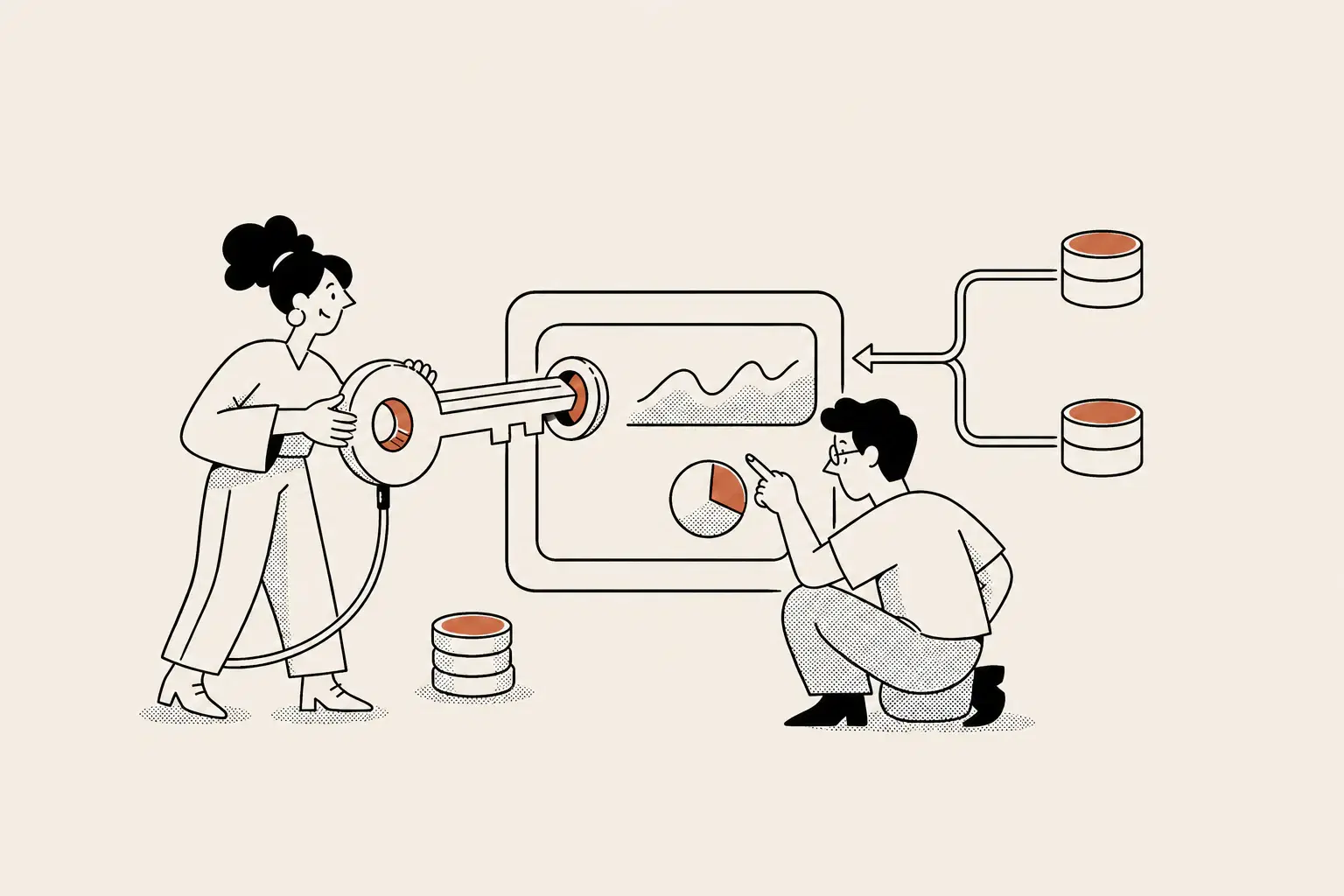
What direct provider billing means
You connect an account you control. Checks run against that account and the provider bills you directly; Bisibility does not resell the data or add a per-keyword markup.
You can switch between supported providers when cost or coverage changes without discarding the rank history already stored in your database.
A check, a page, and a billing unit are different things
In Bisibility, one logical rank check means one keyword in one location on one device for one scheduled or manual run. That product-level check is not necessarily one billable provider unit.
A SERP page or request is one fetched Google results page. DataForSEO bills the pages crawled inside a task, while SerpApi counts successful API searches. The familiar keywords x locations x devices x runs formula counts logical checks; estimating deeper tracking also requires the provider units consumed by each check.
- Top 10: one logical check is typically about one provider page.
- Top 100: one logical check may require about ten provider pages.
- A Google page may contain fewer or more than exactly ten organic results, so page count and returned-result count are not interchangeable.
The default provider request fetches the first search-results page, which typically contains about 10 organic results. Deeper rank tracking requires additional pages.
Bisibility supports configurable top-10 to top-100 depth
Bisibility lets each project track the top 10, 20, 50, or 100 organic results, with an optional per-keyword override. Top 100 remains the default. With DataForSEO, Bisibility sends one Live Advanced request with the configured depth. With SerpApi, it requests one page per ten requested results.
By default, both providers stop crawling once the tracked domain is found. DataForSEO receives stop_crawl_on_match, while Bisibility stops SerpApi pagination locally. A project setting can disable early stop when a complete full-depth competitor snapshot matters more than lower provider usage.
A result with no position means that the tracked domain was not present in the organic results returned within the configured window. It does not prove that the domain does not rank below the requested depth.
1 logical Bisibility check at depth D
= 1 DataForSEO task that may crawl about ceil(D / 10) pages
= up to about ceil(D / 10) SerpApi searches
DataForSEO charges less for later pages in the same task
DataForSEO's Google Organic API defaults to depth=10, but it supports deeper tasks. The first crawled page is charged at the base rate. Each additional page in the same task is currently charged at 75% of that base rate. Ten fetched pages therefore cost 7.75 times the first-page rate, not 10 times.
Under DataForSEO's published ten-page example, a top-100 task costs $0.00465 in the Normal queue, $0.00930 at High priority, or $0.01550 with Live delivery. At 30,000 checks, those figures are $139.50, $279.00, and $465.00 respectively.
Bisibility currently calls DataForSEO's Live endpoint. At that rate, 30,000 top-100 checks are about $465, while 30,000 top-10 checks are about $60. The Normal and High-priority figures describe provider options, not modes currently selected by Bisibility.
These are estimates, not guaranteed charges. DataForSEO may crawl a different number of pages when Google returns fewer or more results per page, and it refunds unused requested depth. Bisibility stores the cost reported by the provider with each completed check; that recorded value is the final source of truth.
Pricing verified as of July 2026.
- DataForSEO has no monthly SERP API fee, but the current minimum account payment is $50.
- A $139.50 monthly usage estimate and a $50 initial payment describe different things: consumption versus cash deposited into the account.
- Bisibility ships per-check provider cost tracking, so actual provider-reported spend remains visible after checks run.
Mode                 First page   Ten pages   30,000 top-100 checks
Normal / Standard    $0.00060     $0.00465    $139.50
High priority        $0.00120     $0.00930    $279.00
Live $0.00200 $0.01550 $465.00SerpApi top-100 uses up to about ten searches in Bisibility
SerpApi bills one successful API response as one search, regardless of how many results it contains. Because Google no longer reliably returns 100 organic results in one request, Bisibility paginates in ten-result steps with start=0 for the first page, start=10 for the second, and so on. A logical check therefore consumes up to about ceil(depth / 10) SerpApi searches, and usually fewer when early stop finds the tracked domain.
The public Big Data plan currently costs $275 for 30,000 searches per month. That can cover roughly 30,000 top-10 checks, but only about 3,000 top-100 checks when all ten pages are fetched. Running 30,000 top-100 checks may require about 300,000 searches and therefore an Enterprise plan with custom pricing.
Dividing $275 by 30,000 gives about $0.00917 per included search. Multiplying that by ten gives an illustrative $0.0917 per logical top-100 check, or $2,750 for 30,000 checks. That is a linear comparison for intuition, not SerpApi's official price for 300,000 searches.
Requested depth   Typical Bisibility SerpApi usage
Top 10            about 1 search
Top 20            up to about 2 searches
Top 50            up to about 5 searches
Top 100 up to about 10 searchesStop on match is the default, with full-depth opt-in
Bisibility enables stop on match by default for both SERP providers. DataForSEO receives stop_crawl_on_match for the tracked domain, and SerpApi pagination stops locally after a match. A domain found on page one can therefore consume less than a domain found on page four or a domain absent from the full requested depth.
The project setting makes the trade-off explicit. Leave it on for lower and more variable provider usage with a truncated SERP snapshot, or turn it off to always fetch the configured depth for complete competitor snapshots.
- Fixed depth: predictable snapshot coverage and usually higher provider usage.
- Stop on match: variable usage and potentially incomplete competitor coverage.
- DataForSEO allows up to ten stop targets and can stop when any or all targets match; Bisibility sends the single tracked domain.
Position means organic rank
DataForSEO distinguishes rank_group from rank_absolute. Bisibility uses rank_group for a matching organic result when it is available and falls back to rank_absolute only when the grouped rank is absent. SerpApi positions are normalized across the paginated organic result pages. Bisibility therefore presents an organic rank, not a separate absolute on-page position that counts ads, local packs, answer boxes, and other SERP features ahead of the result.
This also explains the wording around missing results: not found means not found among the organic results fetched for that check. The user-facing meaning is not found in the requested top 10, 20, 50, or 100.
The calculator prices the depth you choose
Daily checks on 1,000 keyword-location-device combinations produce about 30,000 logical checks per month. Weekly or custom schedules reduce that volume when daily history is not worth the provider cost.
Bisibility's public calculator applies that logical volume to the top-10, top-20, top-50, or top-100 depth you choose. For DataForSEO Live, 30,000 top-10 checks estimate to $60 and 30,000 top-100 checks estimate to $465. For SerpApi, plan selection uses checks multiplied by ceil(depth / 10) searches rather than treating every logical check as one included search.
The result is still a worst-case estimate at the configured depth. By default both providers stop after the tracked domain is found, so actual DataForSEO pages and SerpApi searches are often lower; exhausted Google pagination can also end a SerpApi check early. DataForSEO-reported cost and recorded SerpApi billing units remain the source of truth after a check runs.
When direct provider billing is cheaper
Direct billing is often cheaper when you run enough checks to avoid a suite's per-keyword premium, compare equivalent rank depth, and already have people operating the self-hosted stack. It may not be cheaper after infrastructure and engineering time if you need a managed suite's audits, research, AI visibility, and support.
The useful comparison is total operating cost: provider bill, infrastructure, backups, monitoring, upgrades, and the modules you would otherwise keep in another tool. Recheck provider documentation before budgeting because pricing and pagination behavior can change.
Takeaways
- Bisibility supports top-10, top-20, top-50, and top-100 organic snapshots, with top 100 as the default.
- A ten-page DataForSEO top-100 task currently costs 7.75 times its first-page rate; Bisibility uses the Live endpoint today.
- One Bisibility top-100 check can consume up to about ten SerpApi searches, usually fewer with the default stop-on-match setting, so the 30,000-search plan does not cover 30,000 full-depth checks.
- Not found means the domain was absent within the fetched depth, not that it never ranks below that window.
Related SEO resources
Primary use caseBring Your Own Keys Rank TrackingThe canonical page for provider-key ownership and direct billing.Open resourceGlossaryBYO ProviderWhat it means to connect your own SERP provider account.Open resourceCalculatorRank Tracking Cost CalculatorEstimate monthly provider spend before choosing a schedule.Open resource
Read next
Model logical volume and provider depth together.
Estimate monthly provider spend at the depth you plan to track before connecting credentials or committing to a schedule.